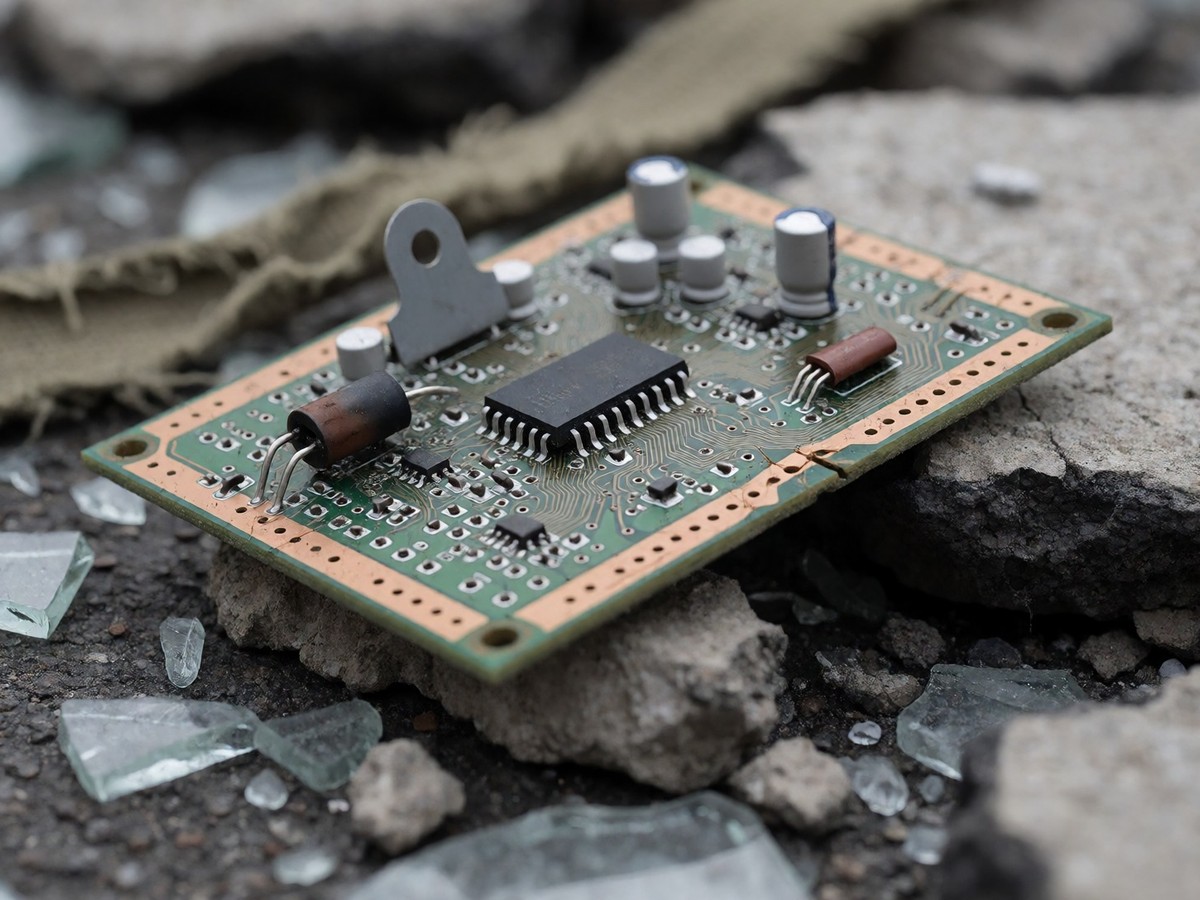
Ukrainian forces shot down a Russian Geran-4 jet-powered attack drone over Kyiv Oblast in mid-August 2026, revealing components manufactured by U.S. and European companies in early 2026. The Alabuga Special Economic Zone produced this drone, which flies faster and higher than earlier models. The wreckage contained nearly 100 non-Russian components, most from American tech companies. Twelve components carried date markings. Manufacturers produced seven parts in 2026 and three in 2025. None of these parts came from pre-war stockpiles. A microcontroller from STMicroelectronics carried the date code 2606, indicating production in early February 2026. STMicroelectronics assembled and tested this chip in Malaysia. A power diode from Vishay Intertechnology showed a date code of 2607, marking its creation in the seventh week of 2026. Timing chips from U.S.-based CTS Corporation showed production dates in January, February, and March 2026. STMicroelectronics stated it has no operations in Russia and maintains trade compliance. Vishay Intertechnology said it blocked all shipments to Russia in February 2022 to prevent violations of export laws. CTS Corporation did not respond to requests. The components traveled from Western-owned factories to the inside of a Russian drone in a matter of months before the aircraft targeted Ukrainians in August.
| Component Type | Manufacturer | Date Produced |
|---|---|---|
| Microcontroller | STMicroelectronics | Early February 2026 |
| Power diode | Vishay Intertechnology | Mid-February 2026 |
| Timing chips | CTS Corporation | January to March 2026 |
Lithuanian SIM cards used for navigation
Russian drones used Lithuanian SIM cards to navigate and stream video during attacks in 2025. Jonas Ohman, co-founder of the Lithuanian organization Blue/Yellow, said SIM cards help drones connect to mobile networks to adjust routes. He described the drones as "a flying mobile phone." The eight recovered cards belonged to Pildyk, a prepaid brand of Tele2 Lietuva. Linas Marcinkevicius, head of credit and risk control at Tele2 Lietuva, said specialized groups purchase and activate these cards for resale to smugglers and agents of hostile states. Foreign SIM cards help Moscow avoid detection because they look like "ordinary mobile communication." Because identity verification was not required in 2024, users activated these specific cards without providing ID. A European Commission spokesperson said the diversion, illegal procurement, resale, or stockpling of already issued cards poses a greater challenge than formal export from the EU to Russia. In some EU countries, SIM cards can still be bought without identification.
Thousands of components bypass sanctions
Investigators identified more than 16,000 foreign-made components in Russian drones and missiles since the full-scale invasion began. These parts bear markings from manufacturers in more than 30 countries. This total exceeds the 6,300 components previously reported by the military intelligence agency, HUR, on the War & Sanctions portal. The Prosecutor General’s Office sent 28 requests for mutual legal assistance to authorities in other countries to trace the supply channels and verify compliance with international sanctions and export controls regarding the 16,000 components. Vladyslav Vlasiuk, the president’s envoy for sanctions policy, said a Geran-5 downed in September contained a transistor from a European manufacturer made in February 2026. Vlasiuk noted that products reach Russia through a chain of three or four intermediaries in third countries. The current sanctions regime fails to prevent the flow of restricted technology to Russia through these complex and evasive third-country networks. Vlasiuk argued that intermediaries need criminal prosecution and manufacturers must take responsibility for their products’ end users to stop this flow. He said financial intelligence must follow the money behind chips in the same way it follows drug money.