The departing envoys
Krzysztof Szczerski, the Polish ambassador to the United Nations, submitted his resignation on Monday. This makes him the third high-level envoy to quit following a move by government-backed judges to take control of the Constitutional Tribunal in Warsaw. Jakub Kumoch, the ambassador to China, resigned on Friday, and Pawel Soloch, the envoy to Romania, resigned on Saturday. All three diplomats previously worked for former President Andrzej Duda. I find the timing of these three senior officials leaving their posts to be a direct consequence of the turmoil at the court.
| Ambassador | Post | Resignation | Duda Connection |
|---|---|---|---|
| Krzysztof Szczerski | UN | Monday, Nov 2 | Head of International Policy Bureau |
| Jakub Kumoch | China | Friday, Oct 29 | National Development Council member |
| Pawel Soloch | Romania | Saturday, Oct 30 | Head of National Security Bureau |
Kumoch described his decision as a "matter of conscience" because certain things he cannot explain abroad without losing face. Pawel Soloch, the former head of President Duda’s National Security Bureau, resigned on Saturday and said the attempt to unlawfully take over the Constitutional Tribunal left him with "no possibility of continuing to serve as ambassador". Szczerski, who has held his UN post since 2021 and previously served as a member of the European Parliament, has not yet commented on his reasons for leaving. Foreign ministry spokesman Maciej Wewior announced on Monday afternoon that Szczerski requested to shorten his diplomatic mission. Kumoch previously served as ambassador to Switzerland and Turkey, while Soloch served in the National Security Bureau from 2015 to 2022.
Conflict at the tribunal
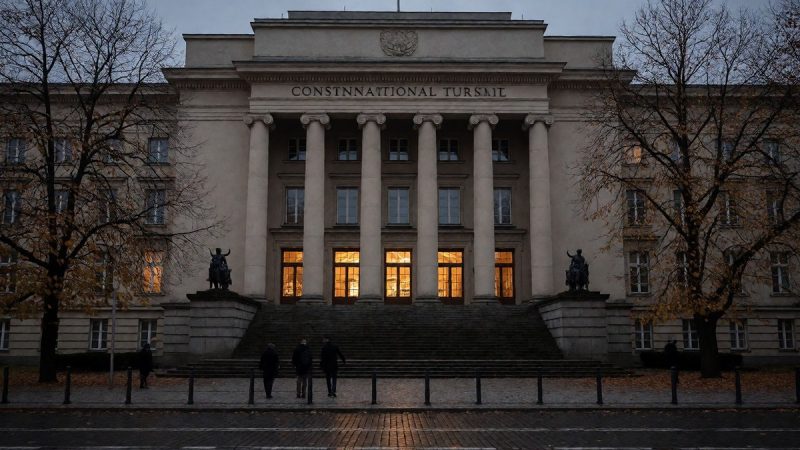
The crisis began Friday evening when riot police surrounded the court. The decision to resign follows the recent move by a group of eight judges appointed by parliament to enter the court and declare that Bogdan Swieczkowski was suspended from his position for failing to fulfil his duties. Five of these eight judges faced refusal from President Karol Nawrocki to be sworn in. Swieczkowski, who served in the former PiS government, called the actions an attempted "coup d’etat". I believe the situation in Warsaw is uniquely volatile after President Nawrocki entered the court on Saturday and clashed physically and verbally with the acting head, Anna Korwin-Piotrowska.
The current government, led by Prime Minister Donald Tusk, does not recognise the tribunal due to the presence of judges appointed under the previous PiS administration. Tusk’s coalition began appointing judges to fill vacancies this year, but Nawrocki and Swieczkowski have refused to accept them. On Saturday evening, Tusk spoke to the nation and declared there can be "no compromise" over the rule of law. He accused Nawrocki of "intimidating judges" during the conflict. Further developments may occur on Tuesday when Korwin-Piotrowska calls a general assembly of the tribunal. However, it is uncertain if she will obtain the necessary quorum of 10 judges normally required for the assembly to be valid. While the eight judges appointed by the ruling coalition this year are expected to attend, those appointed under the PiS government will likely stay away.
Political fallout
Foreign minister Radoslaw Sikorski suggested the three ambassadors quit because of President Nawrocki. He sardonically noted that the trio "will surely be handsomely rewarded for their heroic deeds" in contrast to the ambassadors who resigned in 1981. I find Sikorski’s mockery to be a blunt assessment. The government led by Tusk argues that tough action is necessary to restore the legitimacy of the court. This friction traces back to a 2015 crisis when the PiS government rejected three judges.
Legal experts have expressed doubts over the manner in which Korwin-Piotrowska and her colleagues sought to take control of the tribunal. Many were highly critical of the PiS policies. I see these doubts as a significant complication for the new group of judges. Tusk and his government argue that the refusal of Nawrocki and Swieczkowski to accept the new judges is unlawful.