Deaths in Komyshuvakha
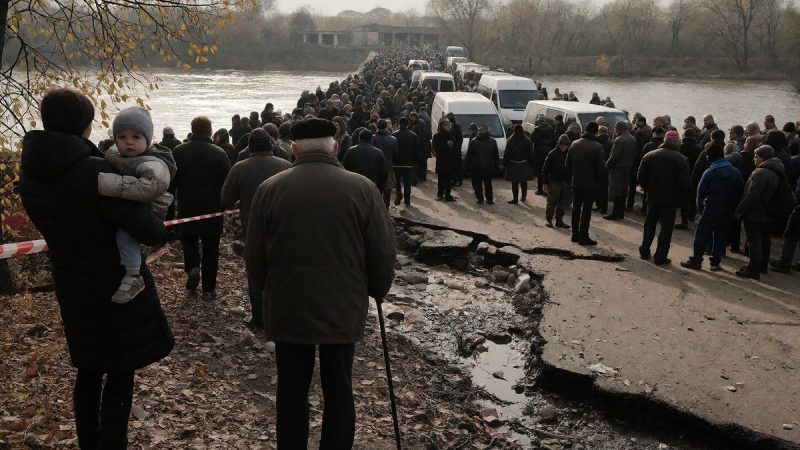
Russian forces killed at least 24 people on Nov. 2 when they struck a school used as a humanitarian aid distribution center in Komyshuvakha, Zaporizhzhia Oblast. The strikes killed two rescue workers, Denys Konovalenko and Oleksii Sushchevskyi, and four police officers. Five other people suffered injuries, including two rescue workers, according to the State Emergency Service of Ukraine (DSNS). President Volodymyr Zelensky said Russian forces launched several aerial bomb attacks throughout the morning, initially striking a school where residents received aid every week before dropping nine additional bombs on a nearby shelter. He called the event an "exceptionally horrific strike" and said Russian forces could not have been unaware that local residents received aid there every week. The two 44-year-old rescue workers are survived by their wives and four children between the two families. Konovalenko served in the civil protection service for nearly 12 years, and Sushchevskyi had worked in fire and rescue units in Zaporizhzhia since 2013. Both men received state awards for their service. The strike destroyed a gymnasium, an outbuilding, and a fire truck, and also damaged the school building. Komyshuvakha sits 20 kilometers from the front line and has been considered a front-line settlement since November 2025, according to the Zaporizhzhia Investigation Center. Russia frequently uses guided aerial bombs known as KABs, which are fitted with wing kits to allow aircraft to strike targets from a distance.
Systematic Russian pressure
Russian aerial pressure continues to disrupt the Ukrainian economy and infrastructure. Air raid alerts forced shopping centers across Ukraine to suspend operations for 32.5% of their scheduled opening hours in October 2026, according to the Ukrainian Council of Shopping Centers (UCSC). This figure is much higher than the 12.2% downtime recorded in October 2025. Nationwide, shopping centers lost an average of 9.8 working days in October 2026 because of air raid alerts.
| Aspect | October 2026 Data | October 2025 Data |
|---|---|---|
| Shopping mall downtime | 32.5% | 12.2% |
| Highest impact regions | Donetsk, Zaporizhzhia, Sumy, Chernihiv, Kharkiv | Donetsk, Zaporizhzhia, Sumy, Chernihiv, Kharkiv |
The security situation for businesses worsened due to the two-tier alert system introduced on Sep. 3. A yellow alert indicates a drone threat, while a red alert signals a missile, combined missile-and-drone or large-scale drone attack. Businesses must move staff to shelters during red alerts. Russian military intelligence (HUR) identified a new Gerbera-2 decoy drone with a 1,200 kilometer range and a 25-kilogram warhead. Investigators found components from the United States, China, Taiwan, Switzerland, Ireland, and the Netherlands in the wreckage of a similar drone discovered in Poland in mid-September. Yurii Ihnat, head of the Air Force’s communications department, said Russian forces launched over 4,000 jet-powered drones and 4,740 propeller-driven drones at Ukraine during October. On Oct. 29, an engine fire at Akhtubinsk airfield in Russia damaged a Sukhoi Su-57 fighter jet.
The Oleshky evacuation
The humanitarian ceasefire in Oleshky, intended to allow for the evacuation of civilians, failed to prevent Russian military movements. Melania Trump stated on Nov. 2 that nearly 800 people were evacuated from the Russian-occupied town, although Kyiv and Moscow have not disclosed official figures. During the humanitarian mission in Oleshky, which was brokered with the help of Melania Trump, the ceasefire lasted from 3 a.m. on Oct. 27 until 11 p.m. on Nov. 1. Ukraine’s General Staff reported that Russia used the "regime of silence" to rotate soldiers, strengthen positions, expand anti-drone netting, and resupply ammunition.
Dmytro Lubinets, Ukraine’s Ombudsman, said that 25 buses with a capacity of 750 passengers were prepared for the evacuation. While the General Staff accused Russia of using the ceasefire to reinforce positions with heavy armored and logistics vehicles, Lubinets claimed the movement seen in drone footage involved equipment used for demining under Ukrainian supervision. Lubinets noted that the equipment carried red crosses and returned to its original positions after the work finished. Residents in Oleshky, which has been under Russian occupation since 2022, faced a worsening crisis when Russian forces deprived them of food and water. The city sits across the Dnipro River from Kherson and has been effectively blockaded by Russian forces, which have prevented humanitarian aid from reaching residents.